I ran a bank through TBPI this week. Let me tell you how it scored before I tell you what it is.
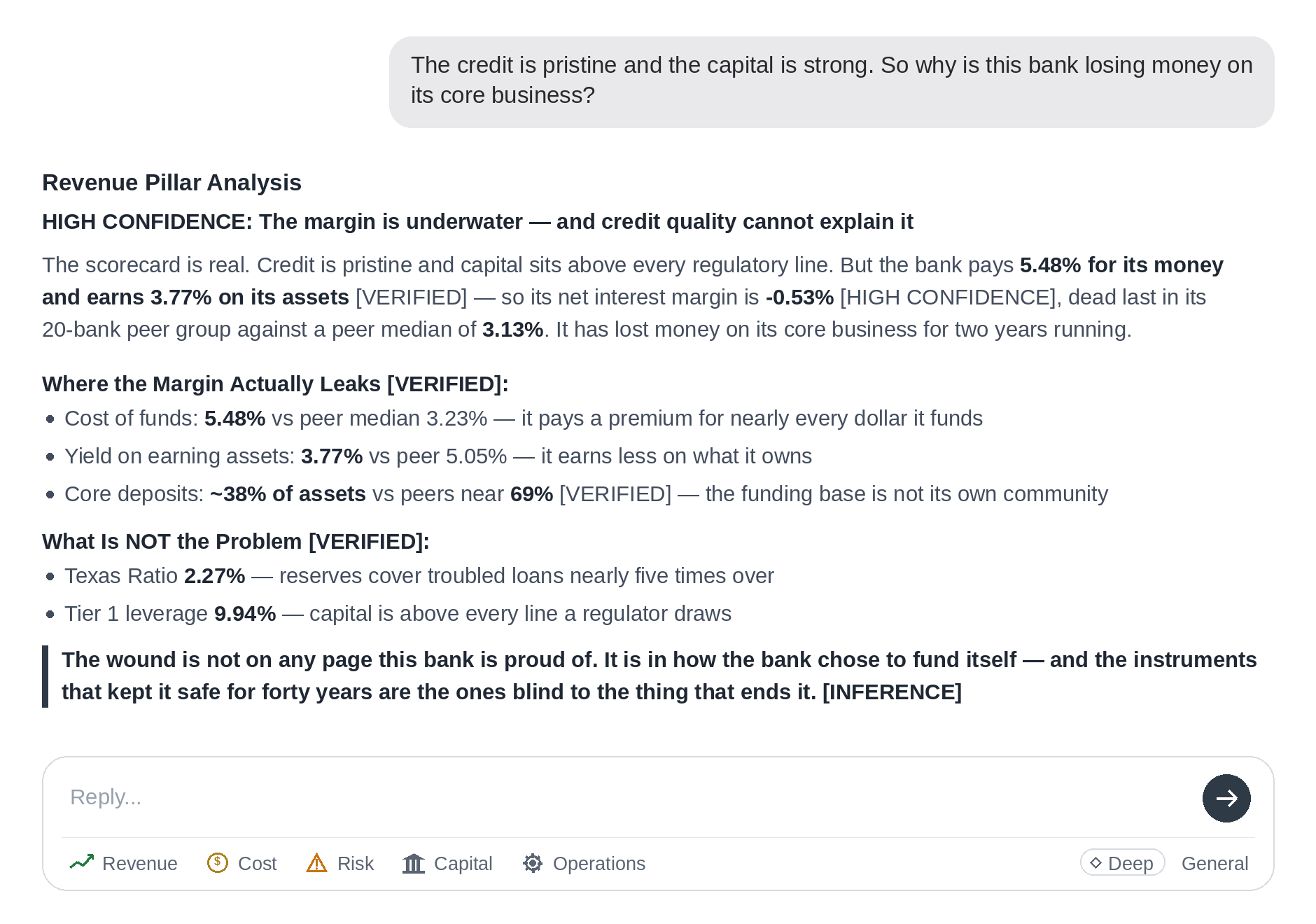
Its credit is pristine. A Texas Ratio of 2.27%, reserves covering its troubled loans nearly five times over [VERIFIED]. Its capital sits above every line a regulator draws — Tier 1 leverage at 9.94%, well-capitalized with room to spare [VERIFIED]. Its overhead is leaner than most of its peers. Hand that scorecard to your board and they'd nod and move on. Most of them already have.
Now the rest of it.
This bank's net interest margin is −0.53% [HIGH CONFIDENCE]. Dead last in its 20-bank peer group, against a peer median of 3.13%. It pays 5.48% for its money and earns 3.77% on its assets [VERIFIED] — so it loses money before a single salary is paid or a single loan goes bad. It has lost money on its core business for two years running. And it cannot fix that by cutting costs or tightening credit — the two reflexes every banker reaches for first.
The wound isn't on any page it's proud of. It's in how the bank chose to fund itself: barely a third of its balance sheet is core deposits from its own community — 37.9% [VERIFIED], where strong peers run near 69%. The rest it rents, at a price that now exceeds what its own loans return.
None of it was hidden. It sat in every board package, next to the numbers that looked fine — which is exactly why no one ever stopped on it.
The question he actually asked
He didn't call me about his margin. He called me with a bigger question, the kind a man asks near the end of a long run: How do I position this bank for the next generation?
Not the next quarter. The next generation. A twenty-year horizon, a question about succession and stewardship and whether the institution he spent a career building outlives the people who built it.
Here is the hard part, and I told him as gently as I could. The bank most in need of asking that question is often the one least able to see why. The instruments that kept this bank safe for forty years — credit discipline, capital strength, expense control — are the very ones blind to the thing that ends it. He had been reading the bank through the lenses he trusted, and those lenses are exactly where the disease does not show up.
It doesn't live on any single page. It lives at the intersection of three decisions made years ago: what the bank chose to lend, how it chose to fund that lending, and whose deposits it leaned on to do it. Each decision, read alone, looked defensible. Read together, against the right peers, they describe a bank paying more for its money than it earns — quietly consuming capital every quarter while every exam it sits for comes back clean.
That's not complication. Complication you can untangle line by line. This is complexity — the kind that only appears when you stop reading the lines one at a time and look at the shape they make together. TBPI doesn't find a number the bank didn't have. It finds the number next to the right number.
The trap inside the trap
There's a second beat here worth your attention, because it's the one that gets banks in this position killed.
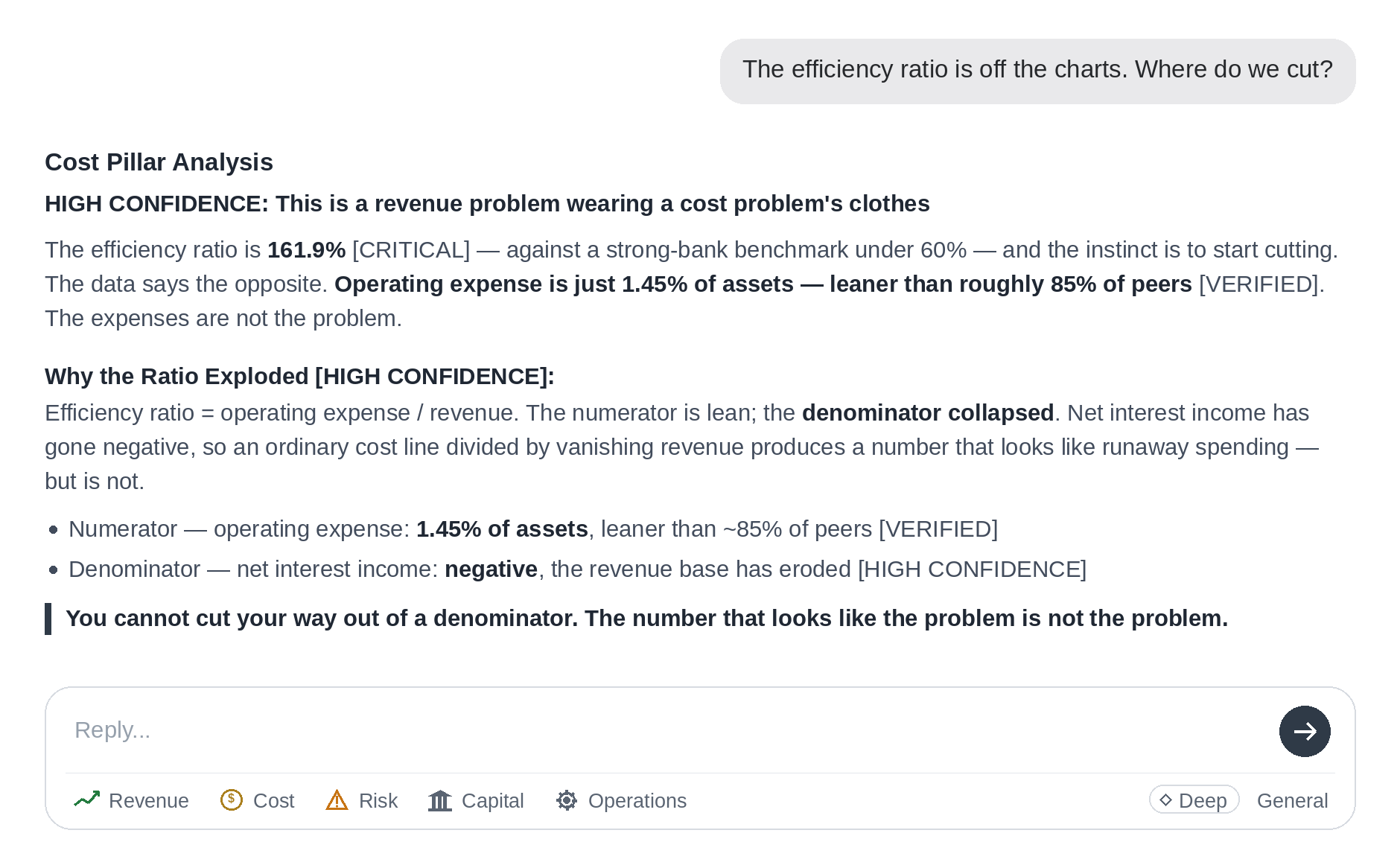
Look at the efficiency ratio and you'd think the problem is cost. It's catastrophic — the kind of number that makes a board start cutting branches and people. But the expenses aren't the problem. TBPI shows operating costs are lean, leaner than most peers. The ratio looks broken because the revenue underneath it collapsed, not because the spending ballooned.
You cannot cut your way out of a denominator. The number that looks like the problem isn't the problem — and a bank that spends the next two years cutting will arrive at the end of them leaner, smaller, and still underwater.
It was never hidden. It had been in the board package the whole time, sitting next to the numbers that looked fine.
A man spends forty years making sure the bank will outlive him. He asks how to hand it to the next generation. And the thing most likely to decide whether there is a next generation was sitting in plain sight, on a page he'd signed a hundred times — next to a credit number so good it told everyone to look away.
Your bank's screenshot could read exactly like this. Clean credit. Strong capital. Lean overhead. And a margin quietly underwater, for reasons no single page will ever show you. The clean tests are not the same thing as a clean answer to the only question that matters.
Why you're getting this
You're still in the first group — the readers I trust enough to tell me whether this earns a place in your inbox.
If it does, forward it to one banker who'd find it useful too. No pitch. No form. Just: if it's worth your time, it might be worth theirs.
Read more
- Issue 1: The Board chose comfort. — read in the archive
- The Wrong Decision (Clarity Article #1) — read on LinkedIn
- The Spreadsheet That's Running Your Bank (Clarity Article #2) — read on LinkedIn
What's next
Next week: the banker in the room. A redacted bank watched its margin climb for years and called it strategy. I'll show you the question that separates the margin you earned from the one the rate curve loaned you — and will eventually call back.
Until then.
— James