There is a specific kind of silence in a bank boardroom after the Board has made the wrong call.
Not the silence of disagreement — that's loud, even when nobody speaks. This is the silence of relief. The hard thing was avoided. The uncomfortable data was explained away. The SOP pointed left, the instinct pointed right, and someone in the room had a slide deck that made left feel like wisdom.
I've been in that room. I've been the one who didn't fight hard enough.
The decision cost us. I won't say how much. But I'll tell you it changed the way I think about what data is for — and what happens when you have mountains of it and none of it thinks.
That's the problem. It was never a shortage of data.
What this is
Seeking Clarity is a weekly newsletter for community bank CEOs and the teams that run with them.
Every Tuesday. One TBPI output from a real bank scenario (redacted). Me, as the banker in the room, walking you through what I noticed and what I'd do with it.
That's the anchor. But clarity requires more territory than one screenshot can cover.
Some weeks that means the economics of NIM compression. Some weeks it means why your organizational structure guarantees that the right information never reaches the right decision-maker. Some weeks it means the psychology of why smart executives look at the same data for three quarters and do nothing. Some weeks it means whether AI in banking is a genuine tool or expensive reassurance with a good marketing budget.
The through-line is always the same: the gap between what your data knows and what your institution does.
That gap has a cost. It shows up in your book value multiple. It shows up in your exam. It shows up in the decision you made last quarter that felt right and wasn't.
No listicles. No thought leadership. No "five trends shaping the future of banking."
Just the work.
I spent more than 20 years in community banking before I built PerLucem. I've been the executive in the room when the data said one thing and the gut said another. I built this because I couldn't find a tool that thought like a banker. Every platform I looked at gave me more data. None of them gave me clarity.
That's what this newsletter is about. Not PerLucem, specifically. The thing the industry actually needs.
Screenshot of the Week #1
This bank looked fine on paper.
Q1 ROA of 1.38%. Net interest margin of 5.09. Efficiency ratio of 57.77 — genuinely good for a bank this size. Tier 1 leverage at 10%. By conventional measures, this is a well-run institution.
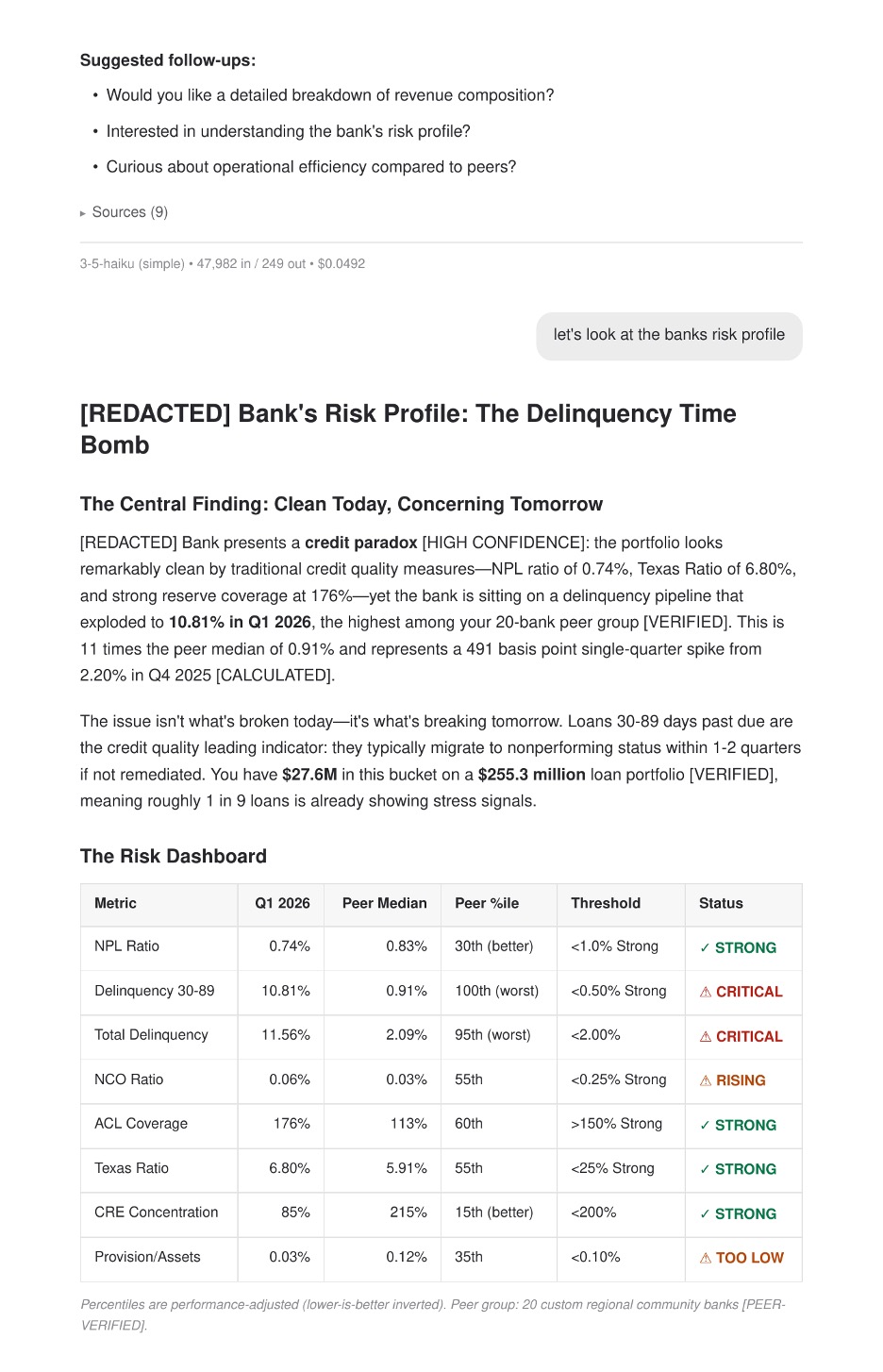
I asked TBPI to look at the risk profile. The surface read held up — NPL ratio of 0.74%, Texas Ratio of 6.80%, reserve coverage at 176%.
Then the model got to the delinquency data.
30–89 day delinquencies had spiked to 10.81% in Q1 2026. That's 11 times the peer median. A 491 basis point jump in a single quarter, the highest in their 20-bank peer group. There's $27.6 million sitting in that bucket on a $255.3 million loan portfolio. The entire exposure is concentrated in one asset class — 77% of the book is 1-4 family first lien mortgages. This isn't diversifiable risk. It's synchronized stress.
Here's the part that would have kept me up at night.
At the precise moment that delinquency pipeline was exploding, the bank stopped building reserves. Q1 2026 provision expense: $0K. Catching up now means $3.13 million in additional reserves — 61% of Q1 equity — and that assumes a mild stress scenario. If 30% of those delinquencies migrate to 90+ past due, reserve coverage falls to 33%. That's the number that brings examiners.
The bank didn't know their delinquency number was that far outside peer. What you're looking at is the question that surfaced it. Five words typed. The delinquency problem resolved into a table — ranked 100th percentile in the peer group, flagged CRITICAL. The data was there. The clarity wasn't.
Want to see this same analysis run on your bank's data? Book 30 minutes with me.
Why you're getting this
You're in the first group — the early adopters I trust enough to tell me whether this is worth reading.
I'm not asking for much. If this is useful, forward it to one banker who'd find it useful too. That's it.
No pitch. No form to fill out. Just: if it's worth your time, it might be worth theirs.
What's next
Next week: NIM compression at a redacted community bank. What the data showed. What the temptation was. What the model said to do instead.
Until then.
— James