There is a slide in almost every strategic plan I read. One line, near the front: reduce CRE concentration, grow C&I. The board nods. The examiner would sign off. It is the most reasonable sentence in the deck.
It has quietly wrecked more strategies than any recession.
Not because the goal is wrong. Because the sentence treats a complex problem as if it were a complicated one, and those are not the same animal.
A complicated problem has many parts, but the parts hold still. You isolate one, fix it, move to the next. A jammed printer is complicated. A broken formula three tabs deep in a spreadsheet is complicated. Hard, sometimes. But the parts wait their turn.
A complex problem has parts that interact. Move one and three others move with it, in directions nobody modeled. CRE concentration in a community bank is not a loan-portfolio problem sitting by itself. It is a funding problem, a margin problem, and a capability problem, all wearing the same name and pulling against each other.
This is also the distinction that should decide how you weigh any AI tool a vendor carries into your boardroom. Most of it is built to improve one number at a time. Improving one number assumes the rest of the system sits still while you work on it. In a bank, nothing sits still. A tool that reads your balance sheet as complicated will hand you a confident answer to the wrong problem.
That is the risk that never makes it onto the slide.
From the Long Form: The CRE Trap
This week's full essay is about a CEO in Texas who did everything the slide told him to. His CRE concentration was past 350% of risk-based capital, the examiners had flagged it, and his board wanted a plan. He gave them the obvious one. Grow C&I, bring the ratio down. Twelve months later margin was down, the C&I book was underperforming, and the concentration ratio had barely moved. He called me and said, "I did what the plan said. It made things worse." He was not wrong. The trap was never the concentration. It was the distance between the obvious answer and the actual one.
Read the full essay: The CRE Trap →
Screenshot of the Week
This bank's board asked for a plan to fix one number. The plan would have broken three others.
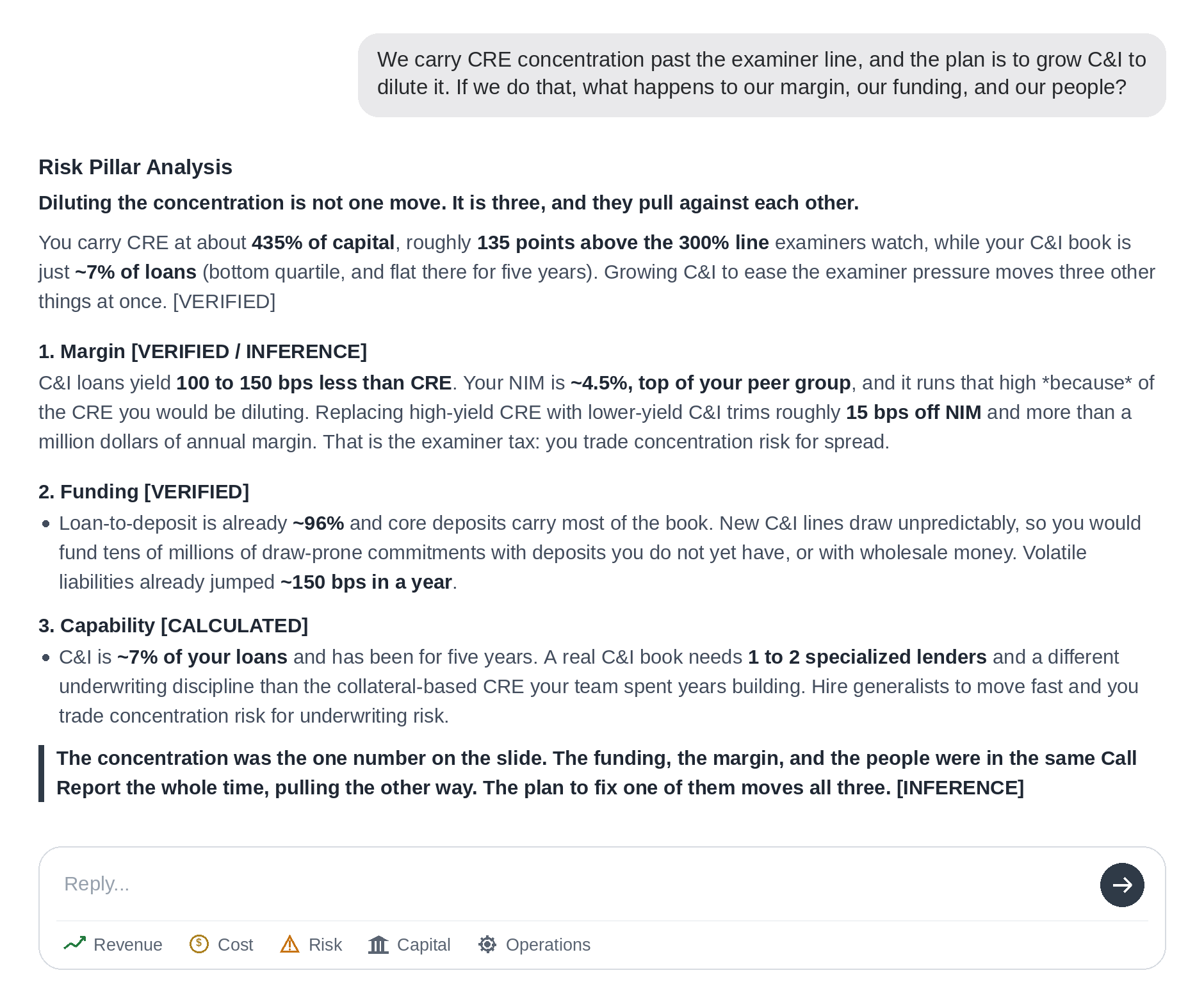
I pulled a Texas community bank into the engine and asked it the question on the slide. Its CRE concentration sits around 435% of capital, well past the line examiners watch. The plan, the reasonable plan, the one every board approves, was to grow C&I and dilute the ratio. So I asked the engine what happens if it does.
It did not give me a number. It gave me three.
Margin first. This bank earns a top-of-peer net interest margin, near four and a half percent, and it earns it because of the CRE everyone wants it to shed. C&I loans yield a hundred to a hundred fifty basis points less. Dilute the concentration and you dilute the margin that made the bank healthy. Run the math out and the pivot costs about fifteen basis points of margin, more than a million dollars a year. That is the examiner tax nobody prices into the slide.
Then funding. Loans already sit at ninety-six percent of deposits. C&I lines draw when you least expect it, so growing that book means funding money the bank does not have, right as its volatile liabilities are climbing.
Then people. The C&I book is about seven percent of loans and has been for years. Building a real one takes underwriters this team never had to be, lending against cash flow instead of dirt.
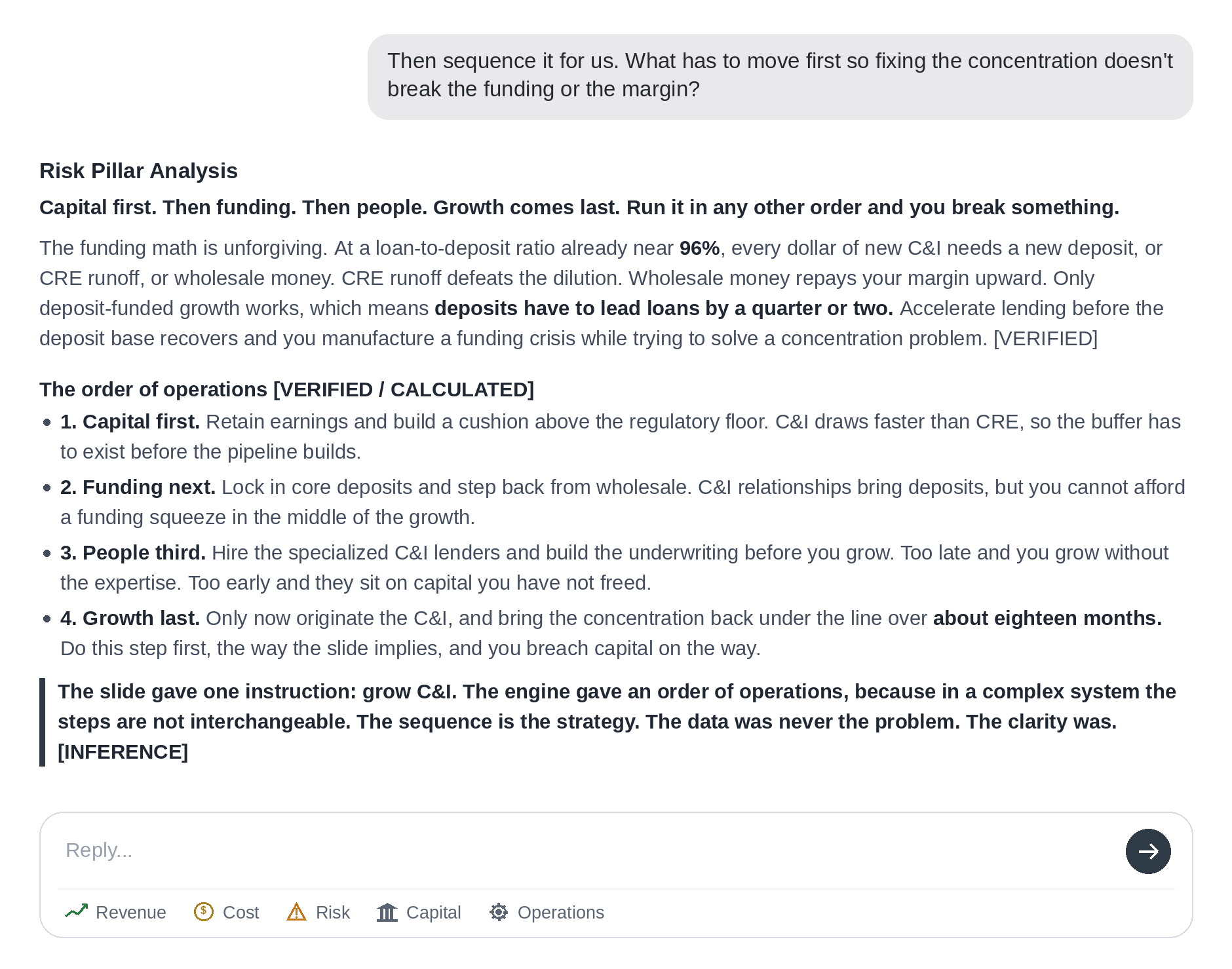
So I asked it to sequence the fix. It would not start where the slide starts.
Capital first, it said. Build the cushion above the floor before you do anything, because C&I draws faster than CRE and the buffer has to exist before the pipeline builds. Then funding. Lock in core deposits and step back from wholesale, because deposits have to lead the loans by a quarter or two. Then the people. Hire the specialized lenders and build the underwriting before you grow, not after. Only then growth, and bring the concentration back under the line over about eighteen months. Run those steps in the order the slide implies, lead with the lending, and you breach capital on the way down.
The slide gave one instruction. The engine gave an order of operations. The sequence is the strategy.
The concentration was the one number on the slide. The funding, the margin, and the people were sitting in the same Call Report the whole time, pulling the other way. The board asked for a plan to fix one number. What it needed was someone who could see all four at once.
The data was never the problem. The clarity was.
Want to see what moves when you touch your own concentration ratio? Book 30 minutes with me.
Why you're getting this
You're still in the first group. The readers I trust enough to ask whether this earns its place in your inbox.
If it does, forward it to one banker who'd get something out of it. No pitch, no form. If it's worth your time, it might be worth theirs.
What's next
Next week: I ran a peer comparison between two banks that look almost identical on paper. One of them should be worried. We'll look at what separates them, and how to see where your own bank sits.
Until then.
— James